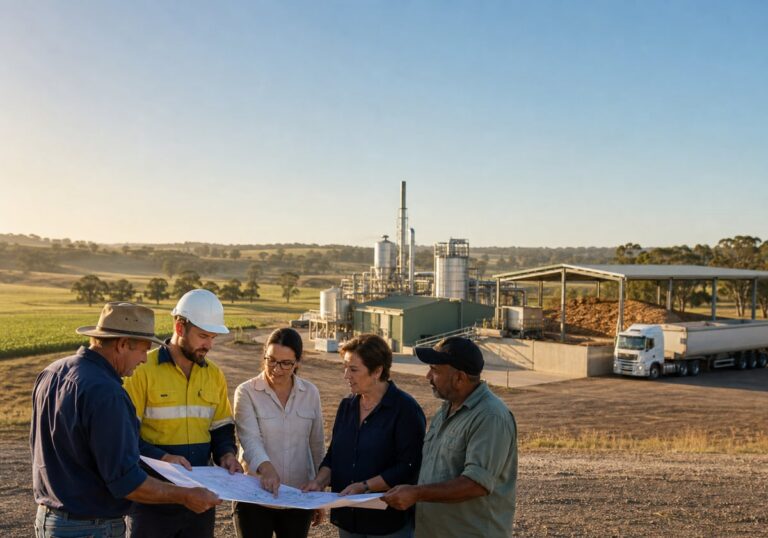
Picture a morning in rural Queensland. A farmer climbs into a tractor cab to begin the harvest — but there’s no diesel to be found at the local fuel depot. The trucks that normally carry grain to the port are parked. The irrigation pumps are silent. Not because anything broke. Because the tanker that was supposed to arrive at the terminal last week didn’t come.
This is not a war scenario. It is not a science fiction premise. It is a foreseeable consequence of a vulnerability Australia has been quietly accumulating for decades — and one that geopolitical events in early 2026, including severe disruption to shipping through the Strait of Hormuz, have made impossible to ignore any longer.
Australia imports the overwhelming majority of its refined liquid fuels. We consume in the order of 50 billion litres of petroleum products annually. Our domestic stockholding sits at roughly 20 to 28 days of supply — well below the 90-day reserve obligation we committed to as a member of the International Energy Agency. We have been in technical breach of that commitment for over a decade.
Until recently, this was a problem that nobody in power seemed particularly motivated to solve.
That may be about to change.
You just have to ask one question: what happens when the tankers don’t come?
Farmers understand that question. Truck drivers understand it. Mining executives understand it. Defence planners understand it. And increasingly — as global shipping lanes become contested and supply chains prove to be fragile — politicians across the full spectrum are going to have to answer it.
The primary case is sovereign capability. The primary case is that Australia should be able to keep food on the table, ore moving to port and beyond, and hospitals running — without depending on a tanker from overseas arriving on schedule.
What Biomethanol Actually Is
Methanol is one of the oldest industrial chemicals we have. Also called wood alcohol — because it was originally produced by heating wood — it has been used as a fuel, a solvent, and a chemical feedstock for well over a century. It powers racing cars. It fuels ships. It is the precursor to biodiesel, to acetic acid, to countless plastics and materials we use every day.
Biomethanol is methanol made from biomass — agricultural residues, forestry waste, sugarcane bagasse, food organics and livestock waste. It is liquid at ambient temperature and pressure, stored in ordinary tanks, with a long shelf life. It can be burned directly in modified engines, used in a fuel cell, or even reformed to hydrogen at the point of use, making it a convenient hydrogen carrier.
Here is the critical point: Australia is extraordinarily well positioned to make it.
Our feedstock potential — agricultural products, tallow, used cooking oil, solid wastes, forestry products — is largely underutilised, exported as low-value materials or treated as waste.
What has been missing is the policy intent and the investment framework to put them together.
Where Biomethanol Has the Most Strategic Impact
Not all uses of biomethanol are equal from a fuel security perspective. Some displace more import dependency than others. Here is where it matters most.
Marine bunkering — the single highest-priority use. Australia is an island continent. Most goods that move in and out of this country move through a port. We are one of the most trade-dependent nations on Earth. And we currently bunker our ships with imported fuel oil, loaded at foreign terminals, delivered by foreign-owned supply chains.
Biomethanol can change that equation, and the technology barrier is lower than most people assume. A small, but growing number of ports around the world offer operational methanol bunkering — the infrastructure is not exotic. A dedicated bunkering vessel, a storage terminal, and the right regulatory approvals are the building blocks.
The challenge is less technical than procedural. Australia knows this firsthand. The Port of Melbourne signed an MOU in April 2023. As of mid-2025, that process had reached the feasibility study stage. By contrast, major ports such as Shanghai and Singapore have moved from pilot to commercial methanol bunkering over a similar timeframe.
The global fleet of methanol-capable vessels stands at 112 in early 2026, with nearly 300 more on order — and those ships need to bunker somewhere on routes that pass through Australian waters. Getting our major ports onto that list is a strategic priority, not a future aspiration.
Sustainable Aviation Fuel (SAF). Australia’s aviation sector currently depends almost entirely on imported jet fuel. Biomethanol, via the methanol-to-jet (MtJ) pathway, can be converted into a drop-in SAF that requires no aircraft modifications and is compatible with existing airport infrastructure.
Major technology providers including Topsoe and Johnson Matthey have developed proven conversion processes. SAF produced domestically from Australian biomass addresses one of the most acute dimensions of our fuel security.
Petrol blending. This is the use case that gets the least attention but may offer a quick practical impact. Both the European Union and China already permit methanol blending into petrol. EU at M3 (3% methanol) can continue using the existing vehicle fleet and existing retail infrastructure, with no engine modifications required.
If Australia adopted equivalent fuel standards, domestically produced biomethanol could be blended into petrol almost immediately, replacing high-value imported fuel additives. No new filling stations. No new vehicles. No new pipelines. Just a policy decision, a blending facility at the terminal and a domestic production industry to keep some of the foreign exchange leaving the country every time someone fills up.
This is genuinely low-hanging fruit. It deserves far more serious policy attention than it has received.
Biodiesel production. Australia already has three biodiesel producers — Biodiesel Industries Australia, Ecotech Biodiesel, and Just Biodiesel — all of whom use imported grey methanol in the transesterification process. Replacing it with domestically produced biomethanol would reduce import reliance across the entire Australian biodiesel chain — a relatively quick win that builds directly on existing infrastructure.
Industrial engines, mining equipment, and irrigation pumps. Australia’s agricultural and resource sectors operate enormous fleets of large-capacity engines — diesel generators, irrigation pumps, mining machinery — that are not easily replaced by battery technology at current costs and at the scale required. Converting these to run on methanol is technically feasible today, with engine conversion technology available from suppliers such as Liebherr. This extends the useful life of existing industrial assets while replacing imported diesel with domestic fuel.
Backup power for hospitals and data centres. Critical infrastructure cannot afford blackouts. Biomethanol-fuelled generators and fuel cells offer a long-shelf-life backup power solution that does not require foreign diesel deliveries to arrive on schedule — a use case with strong near-term commercial interest, particularly as data centre demand accelerates across Australia.
Hydrogen transport. Green hydrogen is difficult to move — it requires either cryogenic liquefaction or high-pressure compression, both costly and technically complex. Methanol, liquid at room temperature and atmospheric pressure, is one of the most practical hydrogen carriers available. Reforming methanol to hydrogen at the point of use — at a service station, a construction site, or a remote industrial facility — is a proven pathway that dramatically simplifies the hydrogen logistics challenge.
Railway and heavy transport. Diesel-electric locomotives are a significant fuel consumer, and electrification faces major infrastructure barriers on long regional routes. Methanol-capable locomotives and methanol-fuelled heavy vehicles — already offered by manufacturers including Geely and Ashok Leyland — provide a viable transition pathway that leverages existing drivetrain technology.
The Race Is On — But Are We Still Tying Our Laces
The federal government has committed $1.1 billion to the Low Carbon Liquid Fuels program. Australia has large, underutilised biomass feedstocks that are currently being exported for low value or wasted. The framework for investment exists. The feedstocks exist. The technology exists.
What is required now is the decision to act — and the policy architecture to back it up. That means recognising biomethanol as a strategic fuel. It means including marine bunkering and petrol blending alongside SAF in the scope of the Low Carbon Liquid Fuels program. It means treating the 90-day IEA stockholding obligation as a genuine national security commitment, not an aspiration we quietly defer year after year.
Geopolitical pressure on global shipping lanes is increasing, not decreasing. Fuel tanker schedules that look reliable today may not look reliable next year. The countries that move first to establish sovereign liquid fuel production — from feedstocks they control, in facilities they own, using technologies that are already proven — will be the ones best positioned when the next disruption arrives.
Australia has everything it needs to be one of those countries.
The only remaining question is whether we will choose to be.
Sunshine Hydro is an Australian renewable energy company developing Superhybrid™ projects that combine pumped hydro, renewable energy generation, and green fuels production. We are actively exploring the commercial viability of domestic biomethanol production for marine bunkering, sustainable aviation fuel, industrial fuel applications, and strategic national fuel reserves. We welcome engagement from government agencies, grant providers, financiers, and industry partners.
Learn more: sunshinehydro.com