
Sunshine Hydro CEO, Rick McElhinney, has just published a critical assessment of an issue that needs to be fixed for hashtag#pumpedhydro, critical infrastructure for Australia in Renew Economy. Rick observes: “When gas companies drill a dry hole, the tax system shares the loss; when we ‘drill a dry hole’ for pumped hydro, we carry it alone.”
Here’s an excerpt from the opinion: “Australia’s electricity system is entering a decisive decade. As renewable energy dominates new supply, one question will determine whether the transition succeeds or fails: can we keep the lights on when the wind doesn’t blow and the sun doesn’t shine?
The Australian Energy Market Operator’s draft 2026 Integrated System Plan makes the scale of the task clear. By 2050, the National Electricity Market will require around 55 gigawatts and 618 gigawatt-hours of storage to maintain reliability and affordability.
This is not a system that can be stabilised with short-duration solutions alone. It requires storage that can deliver for days, provide inertia and system strength, support frequency control, ramp rapidly, and restart the grid after outages. On every one of these measures, pumped hydro is indispensable.
Yet despite its economic and system fitness, pumped hydro remains chronically under-incentivised in Australia’s policy framework.
If offshore gas exploration qualifies for grossed-up deductions and uplifted carry-forward because it is nationally important and risky, long-duration storage should receive the same treatment given its role as critical infrastructure in a decarbonised grid.
When gas companies drill a dry hole, the tax system shares the loss; when we ‘drill a dry hole’ for pumped hydro, we carry it alone.
Australia is not merely suitable for pumped hydro, it is uniquely advantaged. Research led by Professor Andrew Blakers at the Australian National University has identified around 22,000 potential pumped hydro sites nationwide, with an estimated 67,000 gigawatt hours of storage potential.”
Read the full commentary here: https://lnkd.in/gMBS2xyp
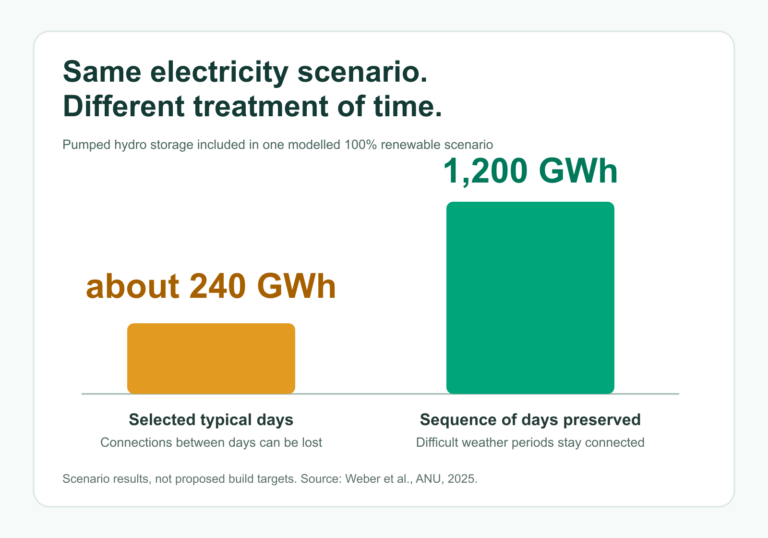
When a model gives the wrong investment signal
One ANU scenario produced very different pumped hydro results depending on how time was represented. Here is what decision makers can ask a model to test next.