Why credible planning needs long duration chronology, realistic forecasts and a portfolio that includes electricity storage and renewable fuels.
A planning result can depend on how the model treats time
Australia needs models to decide where to invest in generation, transmission and storage. The difficulty is that a model can only value a service it has been built to represent.
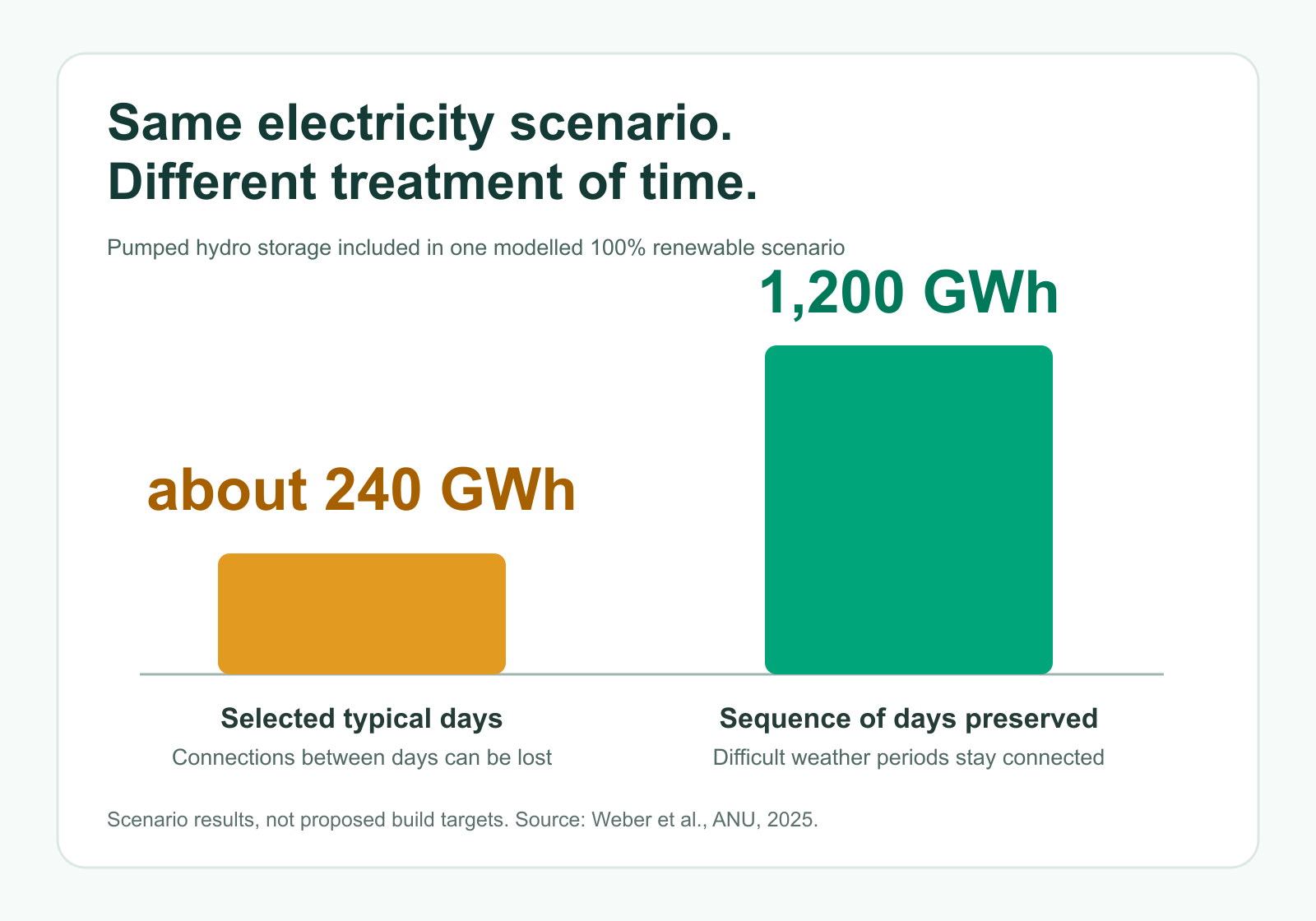
Research led by Timothy Weber at the Australian National University compared ways of representing weather and demand over time in an electricity system model. In one 100% renewable scenario, a version using selected representative days included about 240 GWh of pumped hydro energy storage, while a version that better preserved the sequence of days included 1,200 GWh. The second result was five times larger. The striking point is that changing how time is represented changed what the model found valuable.
Think of a run of cloudy, low wind days. Pumped hydro can save energy before that run and use it during the shortage. If a model replaces the year with a handful of typical days, it can miss the link between preparation and later need. A method that keeps those days connected can recognise more of the value provided by a deep energy reserve.
Two questions before trusting a result
The first question is whether the model follows energy from one day to the next, including difficult stretches of weather. If it does not, the value of long duration storage may be understated.
The second is whether an apparently workable system can actually be operated with the information available at the time. Some planning models know the whole future weather and demand record when they make each decision. This is called a “perfect foresight”. A real operator works from forecasts and revises decisions as conditions change. That difference can matter even when the model preserves every hour in the year.
These are separate checks. Keeping the full sequence of days does not, by itself, remove unrealistic knowledge of the future.
What a decision maker can ask for
The answer is not to discard national planning models. They give a useful view of the whole system. The answer is to test whether an important investment conclusion survives plausible changes in the assumptions.
A decision maker could ask for a comparison between the baseline result and cases that keep a prolonged low wind and low solar period intact. How much storage is built in each case? How often is it used? What happens to reliability and system cost? How sensitive are those answers to storage costs and other assumptions? Results should be presented as a range, not a single certain number.
For a specific project or portfolio, a further operating test can ask whether the assets could deliver their promised service while decisions are made from forecasts rather than future knowledge. Sunshine’s AESOP platform is designed for that more detailed operational question. It complements broad planning; it does not replace it or prove that one national capacity figure is correct.
A clearer basis for investment
The practical lesson is simple: before committing capital, ask whether the planning result holds through the periods the system most needs to survive, and then check whether the proposed assets can be operated with realistically available information. A useful model does not have to be perfect. Its limitations do need to be visible when the decision is made.
Sources
- Timothy Weber and others, *Replacing Gas with Low-cost, Abundant Long-duration Pumped Hydro in Electricity Systems*: https://arxiv.org/abs/2512.20286
- ANU Centre for Energy Systems submission to the Draft 2026 Integrated System Plan: https://www.aemo.com.au/-/media/files/major-publications/isp/draft-2026/consultation-submissions/anu-centre-for-energy-systems.pdf
- Peterssen and others, *Impact of forecasting on energy system optimization*: https://doi.org/10.1016/j.adapen.2024.100181ll