A practical first product can support a broader South Australian green-fuels platform
SA Green Fuels has a clear value-creation strategy: start with biomethanol, build production and customer capability, then grow into additional markets over time.
The project is being developed to turn suitable, sustainably sourced biomass into biomethanol. That provides a practical first product for established international markets while creating a platform for future value in South Australia.
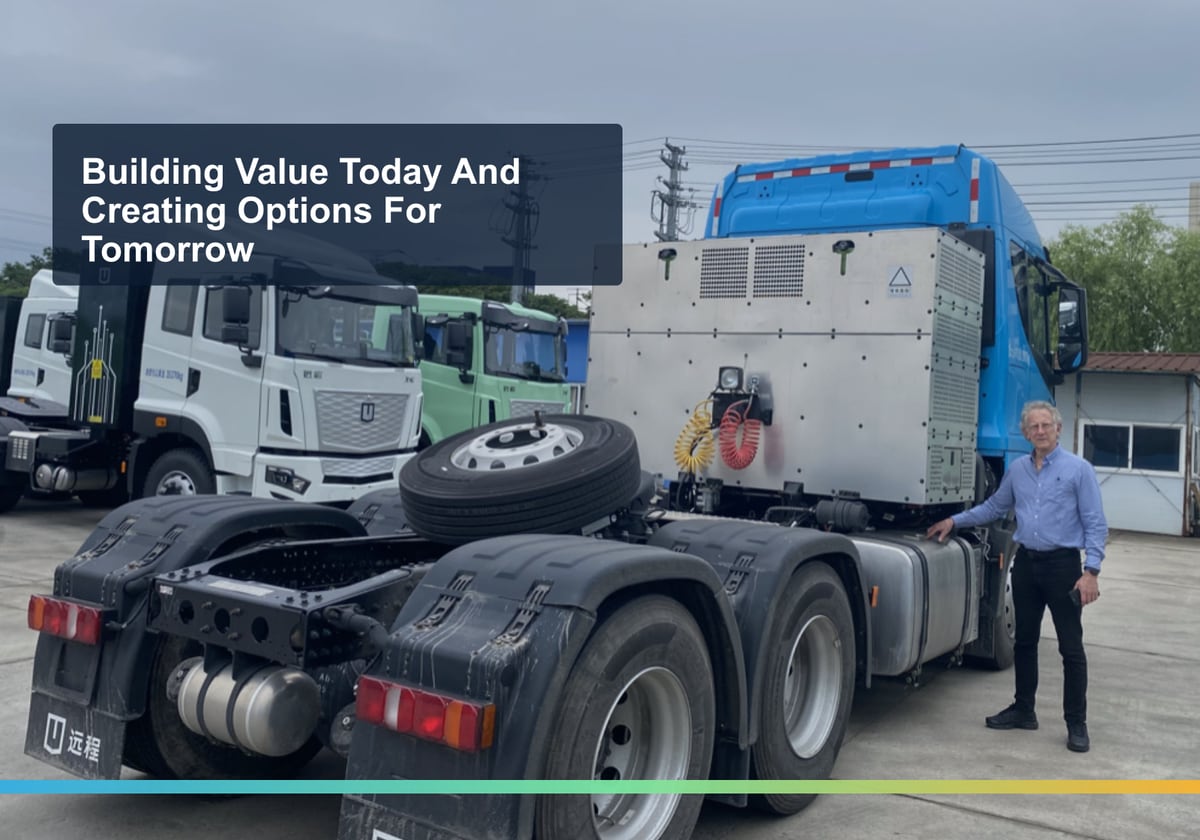
*Photo: Sunshine CEO Rick McElhinney at Farizon's truck factory in China, beside a battery-electric truck fitted with a methanol range extender. Farizon executives told Sunshine during the China visit that 3,500 methanol vehicles shipped last year, providing useful evidence of real-world operating experience.
This is a layered investment story. Biomethanol is the first product, with shipping as the first target market. Biogenic CO₂ can add co-product value. Methanol-powered transport can create domestic demand. Fertiliser and aviation fuels provide pathways for longer-term expansion.
The strength is not that every market must arrive at once. It is that one focused first product can establish the platform from which several markets can grow.
Value starts with biomethanol
Biomethanol gives SA Green Fuels a straightforward place to begin:
- secure suitable and sustainably sourced biomass;
- convert that material into a useful renewable fuel;
- supply a recognised product into established methanol markets;
- build the operating capability and customer relationships that support growth.
Methanol is already used as a chemical feedstock and transport fuel. Shipping is becoming an increasingly important market: the International Energy Agency reported that more than 60 methanol-powered vessels were operating and nearly 300 were on order as of June 2025.
That expanding fleet creates a strong demand signal for renewable methanol. SA Green Fuels is positioned around a product that customers already understand and an international market that is investing in methanol-capable assets.
More value from the process
Biomethanol production can also create a recoverable biogenic carbon dioxide stream. Biogenic means the carbon originated recently in plant material rather than a fossil source.
With the right specification and customer, that CO₂ can become a useful co-product for local industrial applications. Local supply can reduce transport distances and provide an alternative to fossil-derived CO₂ brought from further away.
The same carbon stream can also become a building block for future production pathways. This allows SA Green Fuels to look beyond the value of its first product and consider how more of each process stream can be used productively.
That is the platform advantage: begin with biomethanol, then add value from the assets, skills and material streams developed through the first stage.
A transport opportunity already visible
The Farizon photograph brings one domestic opportunity to life. Rick McElhinney is standing beside a battery-electric truck fitted with a methanol range extender and pointing to its methanol tank.
For shorter routes, the truck can rely mainly on battery power. On longer regional routes, an onboard methanol engine generates electricity to replenish the battery. This combines electric drive for urban and short-haul work with the range and rapid refuelling of a liquid fuel.
Farizon produced its first M100 methanol heavy truck in 2019. During Sunshine's factory visit, Farizon executives said approximately 3,500 methanol vehicles were operating in China. The company-supplied figure points to meaningful real-world operating experience.
For South Australia, this model is particularly relevant to logistics that combine metropolitan deliveries with longer journeys into regional areas. Renewable methanol produced in the state could support an electric-drive transport system without requiring every route to depend on battery range alone.
The Farizon example demonstrates that methanol and electric drive can work together. It gives SA Green Fuels a visible pathway from fuel production to a practical domestic transport market.
Fertiliser and aviation extend the platform
Fertiliser offers another pathway for expansion. Renewable hydrogen and nitrogen can be used to make ammonia. Ammonia can then react with captured CO₂ to produce urea.
Australia's reliance on imported urea makes local production strategically relevant for agriculture and regional industry. For SA Green Fuels, a later fertiliser stage could create another product from renewable hydrogen and carbon captured through the broader platform.
Methanol-to-jet technology also creates a longer-term pathway into sustainable aviation fuel as that market and its approved production routes develop.
These markets have different development timelines, but they give the project several directions for growth rather than dependence on a single customer sector.
A layered value proposition
The SA Green Fuels opportunity can be understood in four layers:
- First market: biomethanol for shipping and other established methanol users.
- Co-product value: biogenic CO₂ for suitable local customers and future production pathways.
- Domestic growth: renewable methanol for transport, including regional logistics and depot-based fleets.
- Expansion markets: fertiliser and future aviation fuels as technology and customer demand develop.
Each layer builds on the capability established by the one before it. Together they create several paths to value, allow investment to be staged and reduce reliance on any single market outcome.
Why this matters for investors
The investment appeal of SA Green Fuels lies in the combination of focus and growth.
The project starts with a defined product and an expanding international market. From there, it can pursue additional value from biogenic CO₂, domestic transport and future industrial products. Expansion can occur in stages rather than requiring every opportunity to be funded on day one.
It also connects commercial growth with wider South Australian priorities: regional industry, productive use of sustainable biomass, lower reliance on imported liquid fuels and fertiliser, and new markets for renewable energy.
This is why the project is more than a single-product plant. It is the foundation for a green-fuels platform with a practical first market and several credible directions for growth.
Building value in stages
SA Green Fuels can begin with biomethanol, establish its operating and customer base, and expand as each additional market develops.
That is a confident but disciplined value proposition: start with a product the market already uses, build useful capability in South Australia and create several ways to grow from the same platform.
As with any major infrastructure project, delivery depends on feedstock, technology performance, approvals, customers and finance. These are the milestones through which the value proposition will be demonstrated. The central message remains clear: SA Green Fuels has a practical first market and several pathways to create additional value over time.
Source And Reference Links
- IRENA, Innovation Outlook: Renewable Methanol: https://www.irena.org/Publications/2021/Jan/Innovation-Outlook-Renewable-Methanol
- IEA, Global Hydrogen Review 2025: https://www.iea.org/reports/global-hydrogen-review-2025/executive-summary
- IMO, 2023 strategy on greenhouse-gas emissions from ships: https://www.imo.org/en/ourwork/environment/pages/2023-imo-strategy-on-reduction-of-ghg-emissions-from-ships.aspx
- Australian Government GreenPower, biogenic CO₂ certification announcement: https://www.greenpower.gov.au/news-and-events/news/lclf-and-biogenic-co2-certification-announcement
- CSIRO, ammonia and reaching net zero: https://www.csiro.au/en/research/environmental-impacts/fuels/hydrogen/ammonia-and-reaching-net-zero
- DCCEEW, Urea Manufacturing Industry technical manual: https://www.dcceew.gov.au/sites/default/files/documents/furea.pdf
- Australian Government, Securing more fertiliser for Australian farmers: https://www.minister.industry.gov.au/t-ayres/media/securing-more-fertiliser-australian-farmers
- Geely Holding, Farizon Auto: https://zgh.com/our-brands/farizon-auto/?lang=en
- United States Department of Energy, Sustainable Aviation Fuel: https://afdc.energy.gov/fuels/sustainable-aviation-fuel
- Sunshine Hydro portfolio: https://sunshinehydro.com/portfolio/