What sits behind Sunshine's project choices
After the last briefing, we received a useful challenge from someone who knows newsletters well: do not write generic energy commentary.
Show people how Sunshine thinks.
That is good advice. A briefing is more useful if it helps readers understand the reasoning behind the bets we are making, not only the polished version after a decision has already been made.
So here is one of the principles sitting behind the way we look at projects:
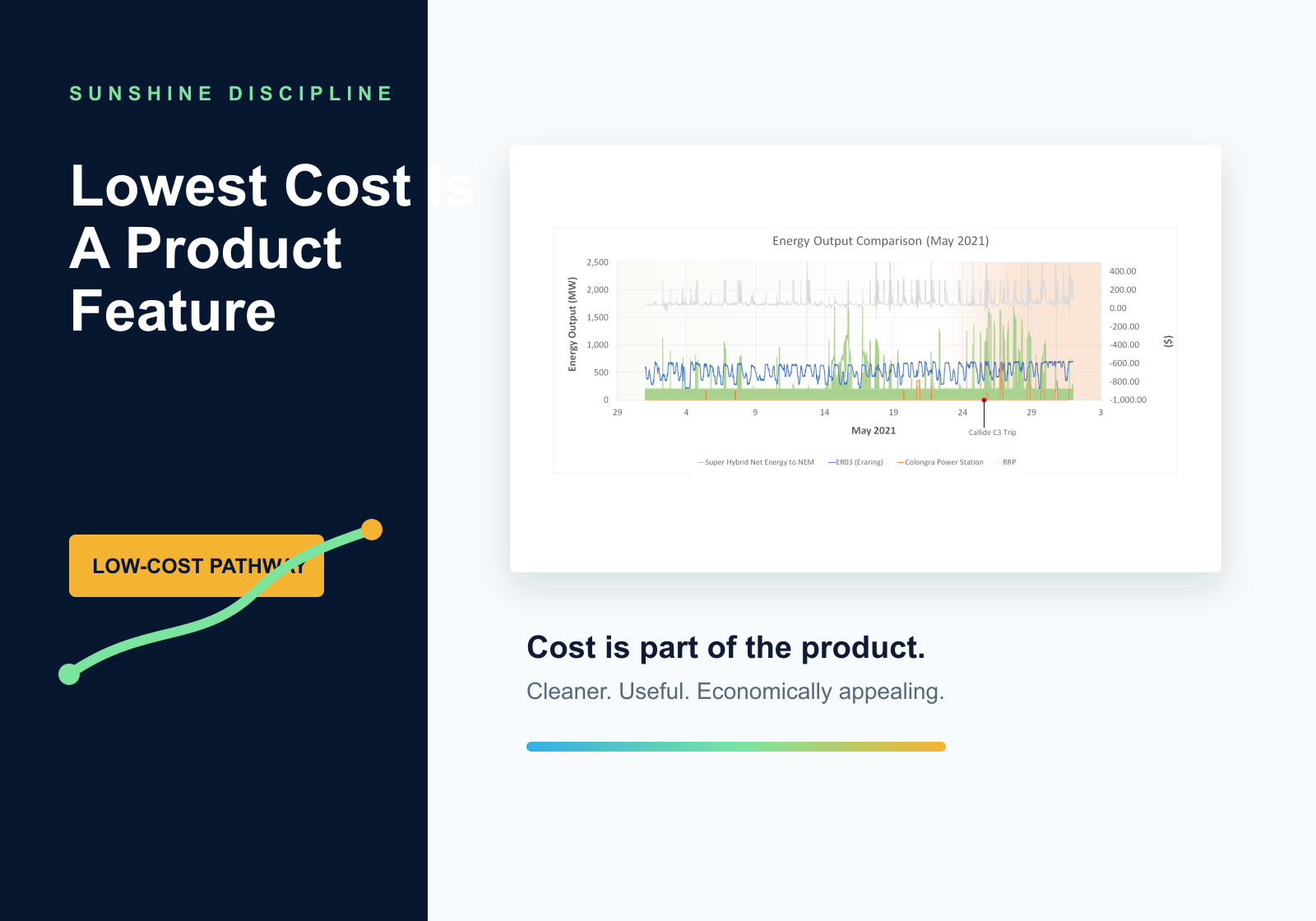
Lowest cost is a product feature.
That may sound like a finance statement. It is not only that. It is a product statement, a customer statement and a discipline statement.
Clean energy products do not become useful simply because they are clean. They become useful when customers can see how they fit into real operations, real budgets and real risk. Some customers will pay a premium for a period. Some markets will use regulation or mandates to bring early products forward. But the long-term test is more practical: can the clean product become attractive enough that customers want to choose it?
For Sunshine, that means cost cannot be treated as something to fix later. It has to be designed in from the start.
The Discipline Behind The Bet
Sunshine works across two main areas: firm clean power and green fuels.
Those are large fields. It would be easy to chase every possible technology, every possible molecule and every possible project that sounds aligned with decarbonisation. But a company can be ambitious and still be selective. In fact, it probably has to be.
The discipline is to ask a harder question:
Where can Sunshine create a product that is cleaner, useful and economically compelling?
That question changes the way we look at opportunity. Technology is only useful if it helps the product become better for the customer. A project is only attractive if its resource base, location, supply chain, operating logic and customer pathway can work together. Complexity is only justified if it improves the product.
That is why cost discipline matters. It is not about being cheap for the sake of being cheap. It is about removing friction. It makes adoption easier to justify. It turns a climate conversation into a procurement conversation, an operations conversation and a resilience conversation.
It also forces better sequencing.
When there are several possible pathways, the first commercial move should not necessarily be the most fashionable one. It should be the one with the strongest practical case: available resources, credible technology, customer relevance, supply-chain logic and economics that can be explained without hand-waving.
Why This Matters In Green Fuels
Green methanol is a good example.
Methanol is a simple molecule made from carbon, hydrogen and oxygen. It is also a useful industrial product. It can be a chemical building block, a fuel in some applications and a pathway into future lower-carbon supply chains.
There are different ways to make green methanol.
One pathway is commonly described as e-methanol. That route uses renewable electricity to produce hydrogen, then combines that hydrogen with a carbon source. E-methanol is strategically interesting, and it may become more important as electrolyser costs fall and customer demand grows.
But Sunshine's current green fuels focus is not to start with the most expensive input if there is a better near-term pathway.
That is why biomethanol is important.
Sustainable biomass already contains carbon, hydrogen and oxygen. In the right project, with the right feedstock and technology, biomass can provide a practical route to methanol without relying as heavily on expensive electrolytic hydrogen at the start.
This does not mean biomethanol is easy. It still requires serious project development, feedstock discipline, technology selection, permitting, customers, logistics and capital. It does not mean every biomass project is attractive. It does not mean e-methanol has no future.
It means Sunshine is trying to start where the cost pathway appears more practical.
What We Learned By Looking Again
The important point is that our thinking has changed as we have learned more.
Early on, e-methanol looked like the obvious clean-fuels pathway. It was elegant. Renewable electricity in, green hydrogen made by electrolysis, carbon added, green methanol out.
But elegance is not enough.
The more we examined the commercial pathway, the more we had to look at the cost of hydrogen, the cost and reliability of inputs, and the kind of customer price a project would eventually need to support. Electrolytic hydrogen remains expensive and operationally demanding. We still expect that cost to improve over time, but a future improvement is not the same thing as a first project advantage today.
That led us back to a more grounded question:
Can sustainable biomass give the first project a better cost base?
Our working thesis is that it can, provided the site, feedstock and technology choices are strong enough.
That is why the SA Green Fuels project matters to us. It is not only a green-fuels idea. It is a test of project selection. The site work has focused on feedstock availability, practical access, scale, partner capability and whether the project can be built around resources that make sense in the real world, not just in a spreadsheet.
Those details are not glamorous, but they are the substance of the bet.
The Site Is Part Of The Product
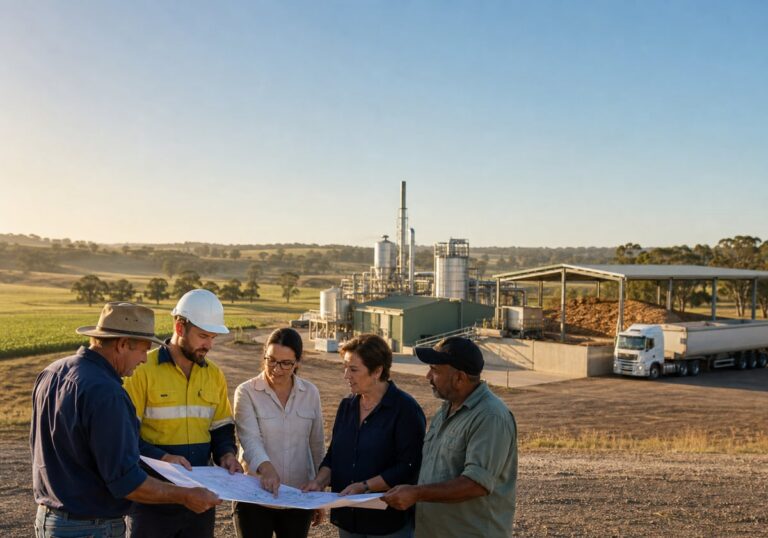
In green fuels, the site is not just a pin on a map.
The site affects feedstock cost, logistics, reliability, weather exposure, operating flexibility, partner quality and community fit. A technically good process in the wrong place can become a poor product. A promising feedstock without scale or access can become a bottleneck. A project that looks good in one season but struggles in another may not support the reliability customers need.
That is why Sunshine has spent time comparing locations rather than simply choosing the first plausible site.
The goal is not to say, casually, that one place is "the best" without evidence. The goal is to identify a location where the main project ingredients can reinforce each other: available sustainable biomass, practical logistics, credible partners, room for scale and a customer pathway that can support the product.
If those pieces come together, lower cost becomes more than an ambition. It becomes part of the product design.
What This Says About Sunshine
This is the broader point for readers.
Sunshine is not trying to win attention by saying every clean-energy pathway is equally ready. We are trying to choose where the first serious moves have the best chance of becoming products customers can actually use.
That is why low cost matters.
It does not replace safety, credibility, compliance, environmental performance or community acceptance. It sits beside them. A product has to be clean, useful, dependable and properly developed. But if it can also be designed around a lower-cost pathway, the customer case becomes stronger.
That is the kind of project we want to build.
And that is the kind of reasoning we will keep trying to share: not just what Sunshine is doing, but why we think the bet is worth making.