The market is moving in the right direction
Australia's storage market is beginning to recognise that duration matters.
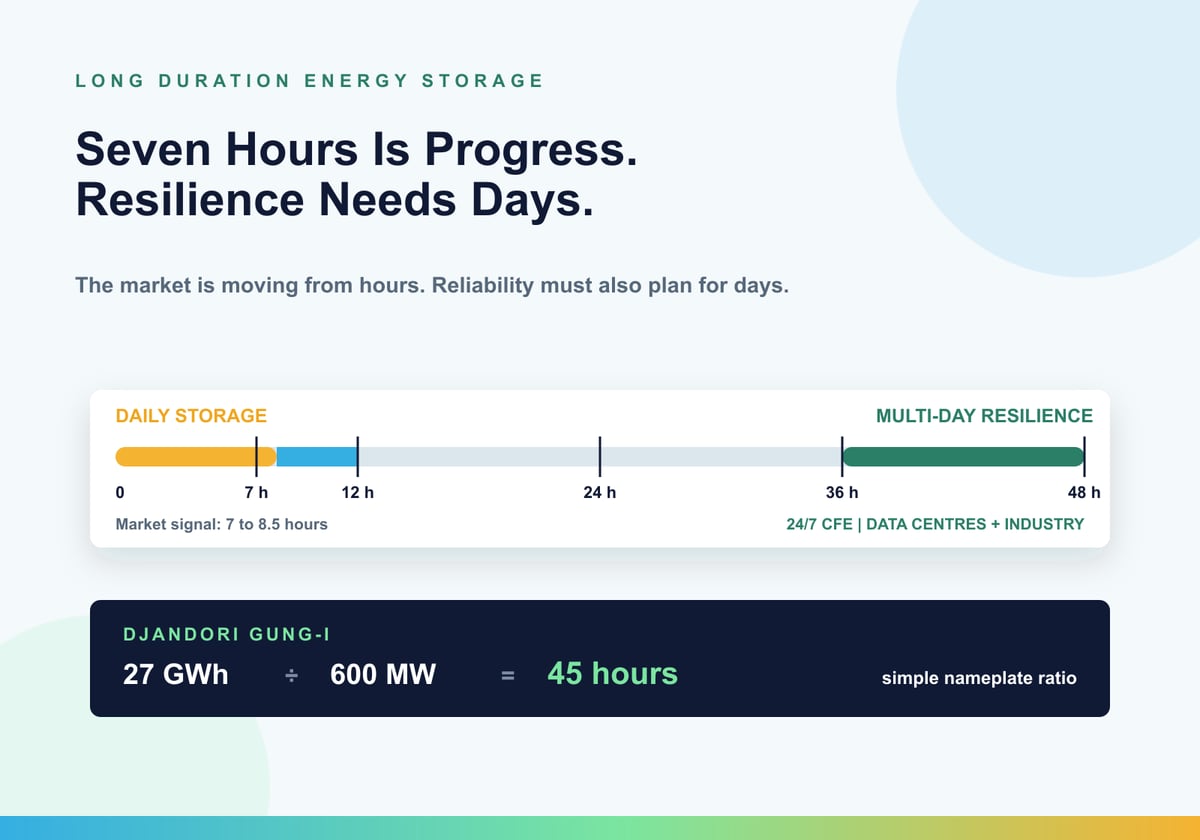
In Western Australia's Wholesale Electricity Market, AEMO is increasing the duration a battery must cover to receive full capacity recognition. The requirement rises from six hours in 2027-28 to seven hours in 2028-29. Sensitivity modelling points toward eight to eight and a half hours later.
South Australia's first Firm Energy Reliability Mechanism agreements cover six battery projects totalling 517 MW and 4,136 MWh. The portfolio has an energy to power ratio of eight hours.
These are encouraging signals. Markets are looking beyond a headline megawatt figure and paying more attention to how long storage can perform.
But seven or eight hours is not the end of the storage discussion.
Seven hours is progress
Seven or eight hours can move renewable energy through an extended evening peak. It can help cover the period after solar generation falls and before demand eases. It is a valuable daily service.
An asset designed for 12 hours can carry supply further into the next day.
But a period of weak wind and solar lasting 36 to 48 hours is a different reliability problem. It cannot be solved simply by stretching an evening battery for a few more hours. It requires a much deeper energy reserve, supported by continued renewable generation, flexible demand and disciplined operation.
Periods of low renewable output are not an argument against renewables. They are a design condition for a system that will rely on them.
Resilience needs days
AEMO's 2026 Integrated System Plan divides storage into shallow, medium and deep categories. Shallow storage lasts less than four hours. Medium storage lasts four to 12 hours. Deep storage lasts more than 12 hours.
By 2030, AEMO projects deep storage will provide about 70% of total storage energy capacity, even though it represents a much smaller share of storage power.
That distinction between power and energy is critical.
A system may have many gigawatts of storage power and still hold too little energy to endure a long renewable shortfall. The important planning question is not only how much power storage can release. It is how long the whole system can continue serving customers through the conditions that matter.
For Sunshine Hydro, the required horizon is clear. Australia should be planning Superhybrid ecosystems capable of supporting reliability through periods lasting 36 to 48 hours, not only through one evening peak.
The industry direction is moving toward days
The International Hydropower Association has proposed a clearer planning framework. It recommends recognising long duration storage from eight hours and deep storage from 24 hours.
Its Australian roadmap also calls for explicit storage targets in national planning and market mechanisms that recognise firming, availability and the long operating life of pumped hydro. Suggested approaches include tailored market entry support, cap and floor arrangements, concessional finance and earlier development assistance.
These are recommendations from the hydropower industry, not current Australian Government policy. Their importance is that they connect the technical need for multi-day storage to the investment conditions required to build it.
Western Australia's move toward seven and eight hours is an important first step. The IHA position shows that the wider industry discussion is already moving beyond daily storage.
Sunshine Hydro's 36 to 48 hour design horizon goes further than IHA's proposed minimum definition of deep storage. That does not mean every project needs the same duration. It means the Djandori Pumped Hydro's scale is aligned with an emerging requirement that storage should be able to support the system through events lasting longer than one day.
The customer needs every hour covered
No energy customer wants a blackout.
For a household, an interruption is disruptive. For a data centre or continuous industrial facility, reliable power is a basic operating requirement. Even a short interruption can affect equipment, production, digital services and customers.
If that facility also wants 24/7 carbon-free energy, annual renewable matching is not enough. The clean supply solution must continue meeting demand every hour, including through extended periods of weak wind and solar.
That is the commercial distinction between daily storage and multi-day resilience.
Seven or eight hours may carry a customer through an evening peak. A period lasting 36 to 48 hours requires a deeper reserve and an energy ecosystem designed around the customer's continuous load.
The product is not a reservoir, a battery or a headline quantity of stored energy. The product is dependable clean power when the customer needs it.
Djandori shows what that scale looks like
Sunshine Hydro's proposed Djandori project has published design figures of 27 GWh of storage and 600 MW of power output.
Dividing stored energy by rated power gives about 45 hours of output. This is a simple nameplate comparison, not a forecast that the project would operate at maximum output continuously in every event. Actual performance would depend on operating conditions, customer requirements, renewable generation and reserve decisions.
The scale is nevertheless important. Djandori sits within the 36 to 48 hour range needed to treat extended renewable shortfalls as a design requirement rather than an afterthought.
This is where the difference between a storage asset and a Superhybrid ecosystem becomes valuable.
Design around the whole event
A Superhybrid ecosystem brings together assets with different roles:
- Deep pumped hydro provides the large energy reserve.
- Wind and solar continue supplying energy whenever conditions allow.
- Batteries can handle rapid response and shorter daily requirements.
- Flexible energy use can adjust when the power system is tight.
The purpose is not to make the system sound more complex. It is to protect the deep reserve and use each asset where it is most valuable.
This is also why storage duration should not be viewed as a contest between batteries and pumped hydro. Batteries are highly useful. Pumped hydro is highly useful. They perform different jobs within the same system.
The better question is whether the complete ecosystem can deliver the required service for the required time at a cost customers and the market can support.
The investment opportunity is the duration gap
Large deep storage projects require substantial capital and long development periods. A recognised system need is important, but it does not create a bankable project on its own. Revenue must be connected to the service being delivered.
Western Australia's capacity arrangements and South Australia's firm capacity contracts show that markets are beginning to pay for longer availability. Firm clean power contracts and other long term customer agreements can value reliability more directly.
The emerging opportunity is to extend that recognition beyond daily storage and connect multi-day capability to customers with large continuous loads.
A data centre or industrial customer seeking dependable 24/7 carbon-free energy may support a long term contract for the core product. A Superhybrid ecosystem with a deep reserve may also support capacity and availability, wholesale market response, grid services and flexible green fuel production. Multiple services do not remove investment risk, but they can create a stronger commercial foundation than energy trading alone.
This does not make every long duration project a good investment. Site quality, delivered cost, approvals, transmission, customer demand and contract structure remain decisive.
It does mean the market is moving toward Sunshine Hydro's central proposition: storage should be designed around the reliability event, and the hardest events last for days.
Seven hours is progress. Resilience needs days.
Source And Reference Links
- AEMO, 2026 WEM Electricity Statement of Opportunities: https://www.aemo.com.au/energy-systems/electricity/wholesale-electricity-market-wem/wem-forecasting-and-planning/wem-electricity-statement-of-opportunities-wem-esoo
- AEMO, 2026 Integrated System Plan: https://www.aemo.com.au/energy-systems/major-publications/integrated-system-plan-isp/2026-integrated-system-plan-isp
- Government of South Australia, Firm Energy Reliability Mechanism: https://www.energymining.sa.gov.au/industry/firm-energy-reliability-mechanism-ferm
- Government of South Australia, Leading the green economy: https://energymining.sa.gov.au/industry/hydrogen-and-renewable-energy/leading-the-green-economy
- RenewEconomy, Sweet spot for battery storage now 7 hours, growing to 8.5 hours, as coal exit looms, 27 July 2026: https://reneweconomy.com.au/sweet-spot-for-battery-storage-now-7-hours-growing-to-8-5-hours-as-coal-exit-looms/
- International Hydropower Association, An Energy Secure Australia: https://www.hydropower.org/publications/energy-secure-australia-pumped-storage-long-duration-energy-storage
- Sunshine Hydro, Our technology: https://sunshinehydro.com/technology/
- Sunshine Hydro, Projects: https://sunshinehydro.com/portfolio/
- Sunshine Hydro, What 24/7 Carbon-Free Energy Really Means: https://sunshinehydro.com/what-24-7-carbon-free-energy-really-means/
- Australian Government, Expectations for data centres and AI infrastructure developers: https://www.industry.gov.au/publications/expectations-data-centres-and-ai-infrastructure-developers