A timing argument for scalable green fuel
The transition to low-carbon fuels is often framed as a technology race. In practice, it is also a sequencing challenge. The critical question is not only which technologies may ultimately dominate, but which ones can be deployed economically today while keeping the pathway open for better solutions tomorrow.
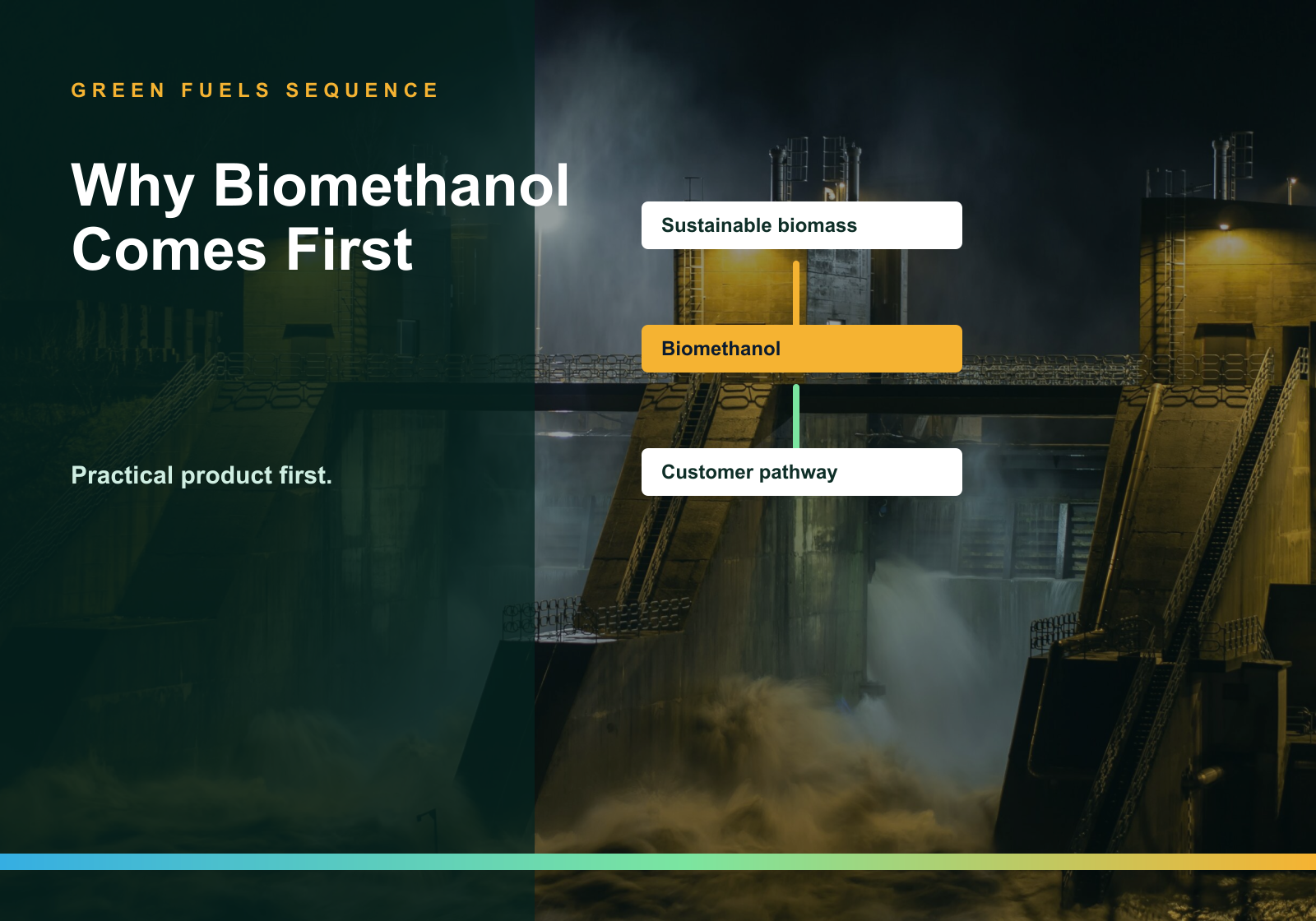
In the case of green methanol, Sunshine's working view is straightforward: biomethanol comes first.
Biomethanol produced from sustainable forestry and agricultural residues appears to be the most practical near-term pathway to low-emissions methanol at meaningful scale, subject to project-specific feedstock, technology and cost confirmation. The underlying process, biomass gasification followed by methanol synthesis, draws on decades of industrial experience in gasification and downstream chemical production. What changes is not the fundamental chemistry, but the feedstock and the configuration of the process.
Biomass contains the essential elements required for methanol production: carbon, hydrogen and oxygen. Through gasification, those elements can be converted into a synthesis gas suitable for downstream methanol production. In many configurations, additional oxygen, often supplied through an air separation unit, helps control the gas composition. There are real engineering challenges in handling heterogeneous biomass feedstocks, but these are better understood as extensions of established industrial systems than as entirely new technological frontiers.
The alternative or later-stage pathway, often described as e-methanol or e-biomethanol, introduces hydrogen produced through electrolysis. Electrolysis is a mature technology, but its project economics are still heavily influenced by the cost of electricity, electrolyser capital cost and utilisation. Under current conditions, electrolytic hydrogen can remain more expensive than the hydrogen already present within biomass.
That cost gap matters for timing. Biomethanol can use existing technology families and regional biomass pathways to create a useful product sooner. It gives customers and project developers a way to start building capability in sectors where methanol already has a role, including shipping, chemicals and industrial supply chains.
Importantly, the biomethanol pathway is not a dead end. It can become a platform.
In biomass gasification systems, not all carbon in the feedstock is necessarily converted into methanol. Some can be lost as carbon dioxide or remain unconverted because of process constraints. That creates a future opportunity. As renewable hydrogen costs decline, electrolytic hydrogen can be introduced to react with those carbon streams, improving carbon efficiency and increasing methanol yield.
In that sense, biomethanol and e-methanol should not be treated only as competing pathways. They can be sequential stages of the same system. Biomethanol establishes the infrastructure, supply chains, operating capability and market demand. e-biomethanol can improve that system over time as economics allow.
The strategic mistake would be to delay useful deployment while waiting for future hydrogen cost reductions. Waiting for low-cost electrolysis risks postponing emissions reductions and slowing the development of industrial capability. Building biomethanol first can capture earlier value, reduce emissions sooner and create assets that remain compatible with future upgrades.
Timing is the central argument. Biomethanol is not simply a transitional solution. It is the first logical step in a staged transition toward more optimised, e-biomethanol production.
That is the practical sequence: build biomethanol first, then integrate hydrogen when it becomes competitive. This approach can accelerate decarbonisation while preserving flexibility for future improvements, so progress is not delayed in pursuit of perfection.
For Sunshine, that is why biomethanol comes first.