What Sunshine’s Djandori modelling shows when wind and solar stay low
On 18 May, the National Electricity Market gave us a useful stress test.
Wind and solar output were unusually low. The previous day had also been weak, making it one of the more difficult multi-day renewable events in recent years. Yet the lights stayed on, and the system did not behave as if the energy transition had failed. Storage, hydro, existing generation and gas all played roles.
For Sunshine, the most important point is this: in the Djandori Gung-i model, the firm clean supply profile kept going through the stress period.
In Sunshine’s modelling, Djandori is configured as a 600 MW very long duration pumped hydro project. The model tests a 400 MW firm green supply profile, tailored to the kind of load a large data centre or industrial customer might need when it wants dependable 24/7 clean power rather than average annual renewable matching.
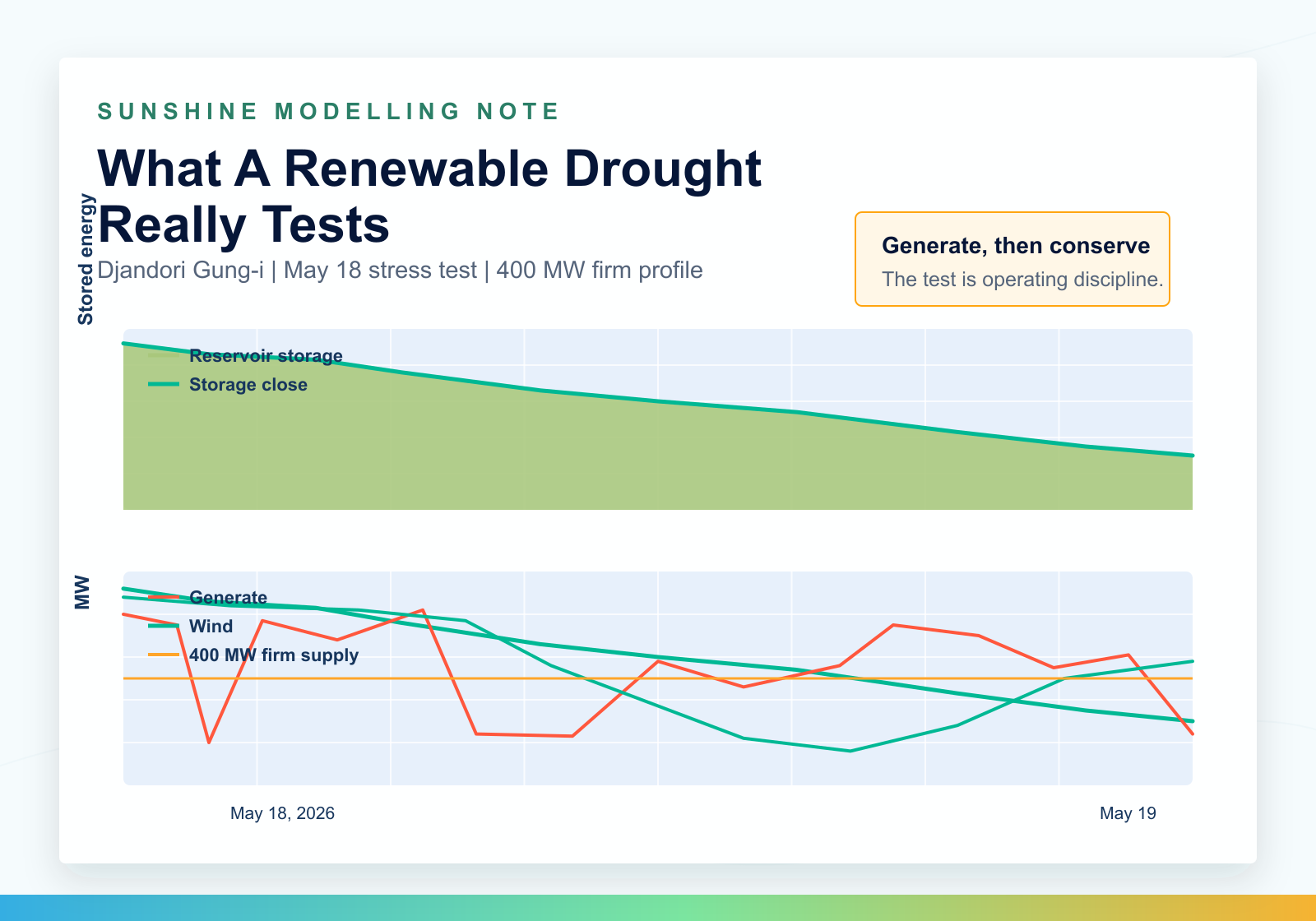
Through the May renewable drought period, the model shows the 400 MW firm green supply profile staying intact.
That is the core result.
The more interesting part is how the model got there.
David Osmond’s modelling, reported by RenewEconomy, points to a useful system-level conclusion: even on an exceptionally difficult renewable day, a high-renewables grid does not necessarily need endless gas backup. With strong storage and hydro in the system, the gas call can be concentrated around the hardest periods, especially the evening peak.
That is an important observation.
But Sunshine’s project question is more specific:
How should a very long duration storage asset behave when the difficult period may last for days?
A storage asset can always look useful in a single high-price interval. The harder test is whether it can support a firm customer commitment, help the system when conditions are tight, and still conserve enough stored energy to remain reliable tomorrow.
That is the kind of operating problem we model when we look at Djandori Gung-i.
What We Were Testing
When we overlay Djandori on a renewable drought, we are not only asking whether the project can generate.
We are asking a more practical set of questions:
- Can it maintain a firm green supply profile for a large customer through a run of low-renewable days?
- When should it generate beyond that customer commitment and support the market?
- When should it stop chasing short-term opportunity and protect stored energy for the days ahead?
- What does this reveal about the real value of very long duration storage?
Those questions matter because clean reliability is not only a capacity problem. It is an operating discipline.
The useful result from the model is not only that Djandori can produce power. It is that the operating logic kept the firm 400 MW profile intact while still allowing the project to support the system when conditions were tight.
That matters because the difficult days are when the reliability promise is tested. A firm clean supply product has to keep working when wind and solar output are low, demand is real, and stored energy has to be spent carefully.
The Judgement Inside The Model
On the difficult day itself, the model allows Djandori to generate additional power into the market when the system is tight and prices are elevated. That is useful. It shows the project can do more than sit behind a single customer profile.
But the operating logic does not simply chase every price signal.
As the event continues, the strategy becomes more conservative. By the evening of 18 May, the model starts to preserve stored energy for the following days rather than chasing every available high-price period.
That is the decision point.
The project has already kept the firm supply profile going. The next question is whether it should keep spending stored energy into the market or protect the reservoir so the customer commitment remains reliable across the rest of the event.
That is what very long duration storage changes. It is not only a bigger battery or a longer generator. It gives the operator more choices, and it makes the quality of those choices more important.
Put simply: it is not enough to win today and fail tomorrow.
In this model run, the intelligence built into the operating strategy makes that trade-off. It can spare energy when doing so is useful. It can also hold energy back when tomorrow’s reliability matters more.
Why This Matters For Gas Exposure
Gas will remain part of the reliability discussion for some time. The practical question is how often it is needed, for how long, and whether clean firming can reduce exposure to fossil fuel volatility over time.
A very long duration pumped hydro asset like Djandori does not remove every system challenge. It does something more specific and more useful: it helps firm renewable supply through the periods when the grid is hardest to serve.
That matters because the most difficult renewable events are not always single-hour problems. They can run across days. They can arrive when demand is high, when prices are volatile, and when customers still need power.
The more clean firming can cover those periods, the less the system has to rely on fossil backup as the default answer.
Why Customers Should Care
Large customers do not run on averages.
A data centre, mine, industrial plant, cold-storage facility or critical service cannot simply wait for better renewable conditions. If the customer wants firm green power, the project behind that promise needs more than renewable energy on paper. It needs generation, storage duration, dispatch discipline, contract design and operating intelligence working together.
That is the gap Sunshine is focused on.
The value of Djandori is not only that it is a pumped hydro project. The value is in how a project like this can be shaped around real customer demand and real system stress. It can store renewable energy when it is abundant, deliver firm clean supply when the customer needs it, and support the market when doing so does not undermine the longer reliability task.
That is a different proposition from simply adding more generation or more short-duration storage.
It is also the practical point that can get lost in simple arguments about renewables. Renewable energy becomes more reliable when it is matched with the right long-duration storage, customer contract and operating intelligence. The model is not saying the weather stops mattering. It is showing how a project can be designed so difficult weather does not automatically break the clean supply promise.
The Bet Behind Very Long Duration Storage
The renewable drought did not tell us that renewables cannot work. It told us that the next stage of the transition has to be designed for difficult sequences, not just normal days.
For Sunshine, that is the bet behind very long duration storage.
The future clean energy system will need assets that know when to generate, when to conserve, and how to protect firm commitments through stress. It will need projects designed around customers, markets and weather risk at the same time.
That is why we keep coming back to the same idea: clean reliability is not just an engineering feature.
It is an operating promise.